
Do Probiotics for Weight Loss Work? A Science-Backed Expert Analysis
Dr. Chomba Chuma
MD & Founder, GutSlim
Are you wondering do probiotics for weight loss work? Dr. Chomba Chuma explores the gut-weight connection and how to support your metabolism effectively today.
As the founder of GutSlim, I am frequently asked the same fundamental question by patients: do probiotics for weight loss work? The interest in the human microbiome as a potential lever for weight management has exploded in recent years. It is no longer just about calories in versus calories out. We now understand that the trillions of bacteria living within our digestive tract play a sophisticated role in how our bodies extract energy from food, signal fullness, and manage systemic inflammation. This shift in understanding represents a major opportunity to support metabolic wellness from within. While there is no single magic pill, the scientific community is increasingly finding that specific bacterial strains may play a supporting role in the complex ecosystem of weight management.
Understanding the Gut Microbiome and Metabolic Health
The human gut contains a vast, diverse community of microorganisms. When this community is in a state of balance, often referred to as eubiosis, it supports optimal metabolic processes. However, modern lifestyle factors such as ultra-processed diets, chronic stress, and lack of sleep can disrupt this balance. This shift, known as dysbiosis, is often associated with metabolic challenges. Research suggests that a less diverse microbiome may contribute to increased energy extraction from food, meaning your body might store more calories than someone with a highly diverse bacterial profile. This concept underscores the importance of nourishing our internal flora to create a supportive environment for our weight management goals.
The Mechanism of Microbial Energy Extraction
Some bacterial colonies are exceptionally efficient at breaking down complex carbohydrates that our own digestive enzymes cannot process. While this was evolutionarily advantageous for our ancestors to prevent starvation, it can be problematic in an era of food abundance. An overabundance of these "energy-harvesting" bacteria may lead to a higher net caloric intake from the same amount of food. By fostering a more diverse environment, we encourage a microbial population that does not prioritize aggressive calorie storage.
Recognizing the Signs of Dysbiosis
Dysbiosis often manifests in ways that extend beyond digestive discomfort. Many patients report consistent brain fog, skin issues, or persistent cravings that seem untethered from their actual hunger levels. These signals are often the body’s way of communicating that the microbiome is out of sync. Addressing these imbalances is not merely about weight; it is about restoring the fundamental communication pathways between your gut and your brain.
The composition of the gut microbiota in obese individuals is significantly different from that of lean individuals, with a reduced diversity of bacterial species often observed in those struggling with metabolic issues. — Turnbaugh et al., 2006, Nature Journal
By focusing on the restoration and maintenance of gut diversity, we address one of the foundational layers of our physiology. It is not about forcing the body into a state it does not want to be in, but rather providing the environmental cues, through diet and targeted supplementation, that encourage a more efficient metabolism. Understanding how this system works is essential for anyone looking to optimize their body composition in a sustainable, non-invasive manner. You can learn more about how specific dietary patterns influence these bacterial communities in our guide on unlocking weight loss with gut health: scientific insights.
The Role of Short-Chain Fatty Acids and Satiety
One of the most exciting areas of gut health research involves the production of short-chain fatty acids, or SCFAs. These are produced when beneficial bacteria ferment dietary fibers in the large intestine. SCFAs like butyrate, acetate, and propionate do more than just nourish the cells lining your colon. They act as signaling molecules that communicate directly with the brain and the endocrine system to influence appetite. By promoting the release of satiety hormones like GLP-1 and PYY, these compounds help you feel satisfied after a meal, which is a critical component of natural hunger regulation. Supporting your gut health is a key step in understanding GLP-1: the gut hormone revolution.
How SCFAs Influence Appetite
When fibers are fermented, these byproduct acids travel through the bloodstream and signal the hypothalamus—the hunger center of the brain. High levels of these SCFAs can act as a natural "brake" on the appetite. They help slow gastric emptying, meaning food stays in your stomach longer and you stay full for an extended duration. This biological feedback loop is often dampened in individuals who lack sufficient fiber-fermenting bacteria.
Bridging the Gap with Probiotics
When we ask do probiotics for weight loss work, we are often asking if they can increase the production of these beneficial SCFAs. Clinical evidence indicates that certain strains of Bifidobacterium and Lactobacillus can help shift the internal environment toward one that favors SCFA production. This physiological shift may help modulate appetite, allowing for more consistent energy levels throughout the day without the constant pull of intense cravings. For further reading on the mechanics of these hormones, check out this external resource from the National Institutes of Health regarding metabolic signaling at https://pubmed.ncbi.nlm.nih.gov/31336049/.
Addressing Inflammation as a Metabolic Barrier
Inflammation is a silent factor in many weight-related struggles. When the integrity of the gut lining is compromised, often called increased intestinal permeability or leaky gut, toxins can enter the bloodstream. This triggers a low-grade, chronic immune response that can interfere with insulin sensitivity and metabolic efficiency. If your body is constantly dealing with this systemic "fire," it becomes much harder to focus on weight management because the system is simply overwhelmed. Probiotics may help support the structural integrity of the gut lining, thereby reducing the triggers for this chronic inflammation. By calming the gut, we create a more stable environment for hormonal balance and metabolic function.
The Link Between Gut Permeability and Insulin
When the gut lining is stressed, it allows bacterial components called lipopolysaccharides (LPS) to escape into the circulatory system. This causes the body to ramp up its inflammatory defenses, which in turn leads to insulin resistance. When insulin signaling is disrupted, the body struggles to process glucose effectively, often shifting the metabolism toward fat storage. Supporting the gut barrier is therefore a crucial step in maintaining healthy insulin sensitivity.
Practical Strategies for Gut Barrier Support
Consistency is the most vital component when working to support the intestinal lining. Beyond high-quality probiotics, consider incorporating bone broths or fermented vegetables, which contain amino acids and beneficial compounds that support the gut’s structural integrity. Reducing intake of artificial sweeteners and highly emulsified foods can also prevent further irritation to the lining. By choosing foods that are naturally anti-inflammatory, you provide the microbiome with a reprieve, allowing it to focus on its primary function.
The gut microbiota plays a crucial role in maintaining the intestinal barrier, and its disruption is closely linked to metabolic endotoxemia, a condition that promotes systemic low-grade inflammation and metabolic dysregulation. — Cani et al., 2008, Diabetes Journal
It is important to remember that this process is a marathon, not a sprint. We must consistently supply the gut with the necessary resources to maintain this barrier. A balanced approach that combines probiotic support with anti-inflammatory foods can be highly effective. If you are struggling with persistent digestive issues that may be linked to this inflammation, consider reading our insights on identifying and healing 5 signs of gut inflammation. Addressing these internal signals is far more effective than trying to override your biology with restrictive measures alone.
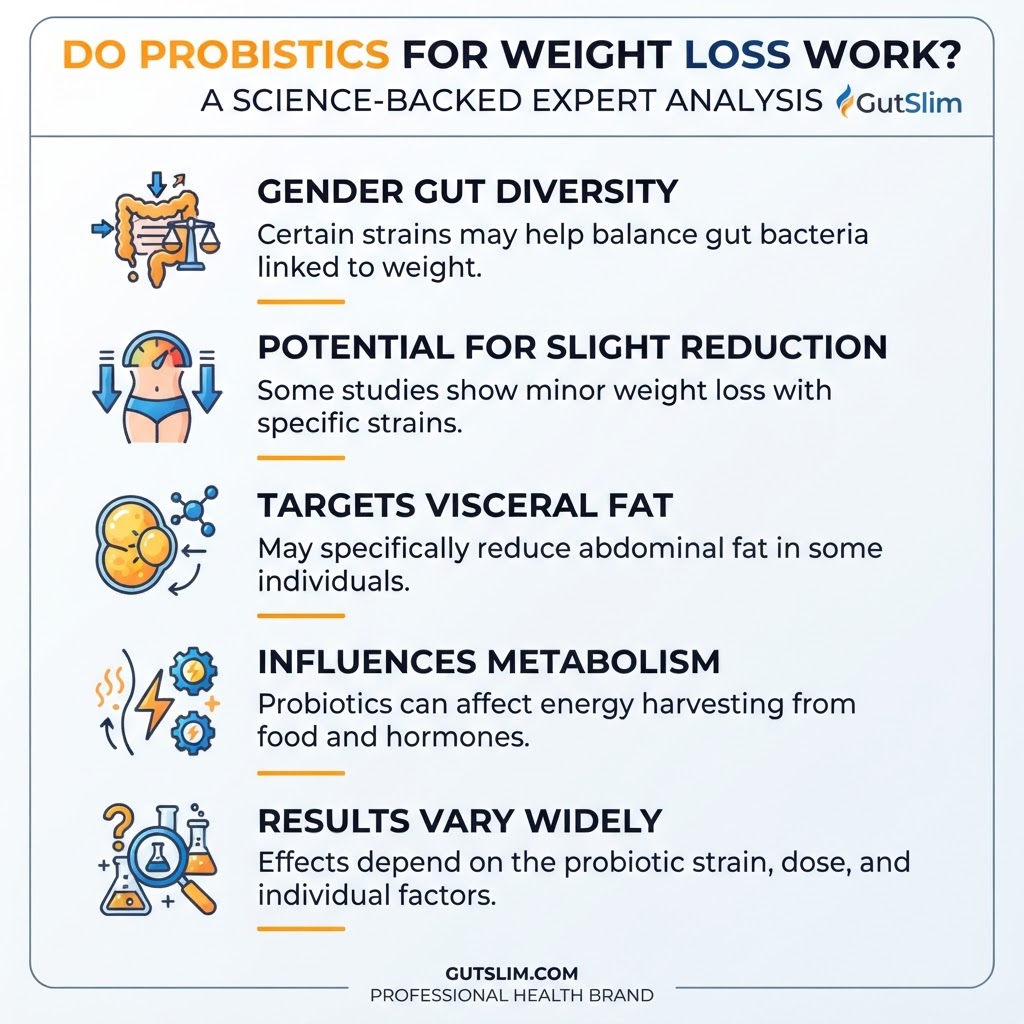
Infographic: probiotics for weight loss do they work
Selecting the Right Probiotics for Your Goals
Not all probiotics are created equal. The market is saturated with generic supplements that may not offer the specific benefits required for metabolic support. When considering if probiotics for weight loss work for your individual needs, look for evidence-based strains. Scientific studies have shown that specific strains, such as Lactobacillus gasseri, have shown promise in supporting abdominal fat reduction in clinical settings. The goal is to choose a formula that provides high-quality, viable organisms that can actually survive the trip through the harsh acidic environment of the stomach to reach the intestines where they are needed.
Understanding Colony Forming Units (CFUs)
While a high CFU count is often touted as a mark of quality, the reality is more nuanced. It is not just about the number of bacteria; it is about the viability of those bacteria. A supplement with ten billion well-protected, diverse organisms is often far more effective than a supplement with fifty billion organisms that are destroyed before they even reach the small intestine. Prioritize products that provide documentation on their survival rates.
The Importance of Strain Specificity
In the world of microbiology, the specific strain name is everything. For example, Lactobacillus acidophilus is a genus and species, but adding a string of numbers like "-NCFM" denotes the specific strain. Research conducted on one specific strain may not apply to another of the same species. Always look for brands that disclose their specific strain numbers, as this indicates they are using the same formulations tested in clinical trials.
Advanced Delivery Technology
Furthermore, consider the delivery system of the probiotic. Technology, such as Velobiotics, utilizes sophisticated coating methods to ensure the survival of the bacteria. This is vital, as a probiotic that does not reach the colon alive cannot perform its function. You can explore the benefits of advanced delivery systems for metabolic support by viewing our specialized product at https://www.velobiotics.com/products/gutslim-probiotics-glp-1-booster. Remember, always consult with your primary healthcare professional before starting any new supplement regimen to ensure it is appropriate for your specific health history and needs.
Integrating Probiotics into a Sustainable Lifestyle
Supplements are most effective when they act as an anchor for a broader, healthy lifestyle. Relying on a pill without considering your broader intake of fiber, hydration, and movement is unlikely to yield the results you want. Probiotics need "food" to thrive, which comes in the form of prebiotic fibers. These are found in foods like garlic, onions, leeks, and asparagus. By combining your daily probiotic with a diet rich in these plant-based fibers, you are effectively creating an ecosystem where your beneficial bacteria can flourish. This symbiotic relationship is the secret to getting the most out of your gut health efforts.
Maximizing Prebiotic Intake
Think of prebiotics as the fertilizer for your internal garden. To ensure your probiotic bacteria have the resources they need, try to rotate your fiber sources throughout the week. Incorporating diverse plant foods—such as Jerusalem artichokes, chicory root, and slightly under-ripe bananas—provides a wider array of fibers that support a broader range of bacterial species. This variety is key to building a resilient, diverse microbiome.
The Impact of Hydration and Movement
Exercise also plays a profound role in this equation. Regular physical activity has been shown to increase the diversity of the gut microbiome independently of diet. When you combine movement, a fiber-rich diet, and targeted probiotic support, you are hitting your metabolism from multiple angles. Proper hydration is also critical, as the metabolic processes of fermentation require water to move waste through the digestive system efficiently. For more information on how to support your body's natural processes, refer to the World Health Organization guidelines on healthy diets at https://www.who.int/news-room/fact-sheets/detail/healthy-diet. Small, consistent actions are what build the foundation for long-term well-being and effective weight management.
Addressing the Reality of Weight Management
It is essential to maintain a realistic perspective. There is no instant fix or miracle cure in the world of weight management. Our bodies are remarkably resilient but also complex. When we discuss whether probiotics for weight loss work, we are discussing a tool for support, not a replacement for medical care or balanced nutrition. Weight management is a multifactorial process involving genetics, environment, psychology, and physiology. Probiotics serve as an excellent, science-backed way to support your gut's role in this process, but they work best as part of a larger plan that respects your individual needs.
Moving Beyond the Scale
If you have been struggling for a long time, please be kind to yourself. The journey of managing your health is unique to you. It is often helpful to focus on how you feel rather than just the scale. Are your energy levels more stable? Is your digestion more comfortable? Do you have less bloating? These are often the first signs that your gut health is improving. These internal markers are excellent indicators that you are moving in the right direction.
The Importance of Personalized Care
Always remember to discuss any major changes in your wellness plan with a medical professional who understands your history. Because every person's microbiome is as unique as a fingerprint, what works for one individual may not provide the same results for another. A qualified practitioner can help you monitor your progress and make necessary adjustments to your supplement routine. By prioritizing personalized support, you can ensure that your metabolic health journey remains safe and effective for your specific circumstances.
Your First Step Toward Better Gut Health
Taking charge of your gut health does not need to be complicated. The simplest step you can take today is to add one serving of fiber-rich, prebiotic-containing food to your dinner, such as a side of roasted leeks or steamed asparagus. This small change provides the fuel your beneficial bacteria need to thrive. If you are ready to take a more proactive approach, you can explore our range of science-backed metabolic support solutions at https://www.velobiotics.com/products/gutslim-probiotics-glp-1-booster. Whether you are starting with our starter packs or looking for a long-term plan, we are here to support your journey toward better metabolic wellness. Stay consistent, trust the process, and remember that every small change counts. We invite you to subscribe to our GutSlim newsletter for weekly tips, recipes, and science-based insights on optimizing your gut and your metabolism for life.
Dr. Chomba Chuma
MD & Founder, GutSlim
Dr. Chomba Chuma is a medical doctor and gut health specialist with over a decade of clinical experience. As founder of GutSlim, she is on a mission to help people transform their health through the power of the gut microbiome.
Get gut-smart, one email at a time.
Science made simple, practical tips and member-only offers from GutSlim. No spam, unsubscribe anytime.
Related Articles
Ready to transform your gut health?
Take the free 2-minute Gut Archetype Quiz and discover your personalised protocol.
Take the Free Quiz →